Animal Damage Control
EnviroWatch would like to take this opportunity to ask the public’s help in halting the senseless killing of the laysan albatross (Diomedea immutabilis) by USDA Wildlife Services in Hawai’i.
For at least 10 years the United States Department of Agriculture’s Animal Damage Control, now known as USDAWS, has been killing thousands of laysan albatross and their young, and destroying their eggs. This practice is done with the authorization of the United States Fish and Wildlife Service USFWS) and the Hawaii Department of Land and Natural Resources (DLNR), both of whom issue annual permits to conduct the activity. There is no limit to the number of birds that USDAWS can kill under the permits, nor are there any regulatory or monitoring programs set up by the issuing agencies. The only requirement is an annual report used to lull the public into a feeling that the activities are being regulated. Other than that the USDAWS is left to do as they please.
Information gathered by EnviroWatch indicates that there is a complex game going on to hide the actual number of Laysan albatross killed by USDAWS and the various governmental agencies involved. It has also been noted that the United States Navy, Marines and Army play a part in the cruel and deadly practice of killing albatross.
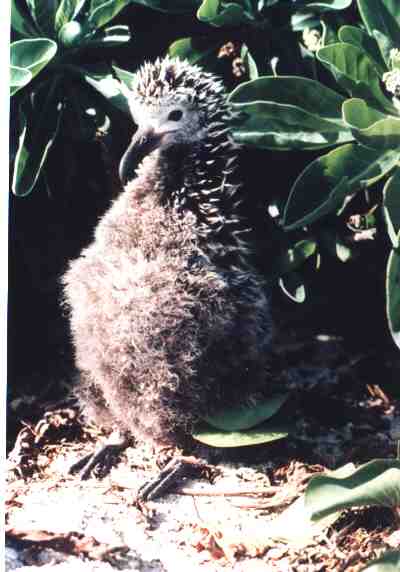
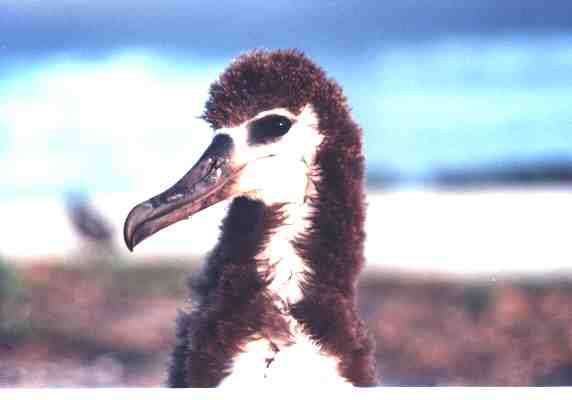
First, a bit about the Laysan albatross. They nest in large numbers, mainly in the northwest Hawaiian Island chain, but also on Oahu and Kaua’i - at Kilauea Point National Wildlife Refuge and Barking Sands Beach. They are approximately 32" tall with a wing span of 6 feet. Their basic colors are black and white, with pale pink bills and legs. They nest by scooping up a small mound of sand and laying a single egg in a depression they create in the middle of the mound. They generally arrive in the islands to nest around November and depart in late spring.
Here is what EnviroWatch has uncovered: USDAWS obtains annual migratory bird permits from the USFWS and scientific collector’s permits from the DLNR. They then contact various military groups and airport managers at small airports, such as Dillingham Airfield, where they contract to eradicate the albatross for a fee. Their methods are to remove the chicks from the nest and kill them, break up any eggs still in the nest, destroy the nest, and then either kill the adults or capture and relocate them - usually to an area where they are released and later killed by packs of wild dogs residing nearby.
However, to avoid public scorn USDAWS has created a "smoke screen" scheme that involves the delivery of some of the eggs to Professor Causey Whittow at the University of Hawaii, for use in scientific experiments. There they are either destroyed in the experiments or incubated and allowed to hatch, only to be killed in other experiments. USDAWS also claims that they have taken some of the chicks to Sea Life Park to be cared for by park personnel. On July 3, 1997, EnviroWatch contacted Marlee Breese, Curator of Animals at Sea life Park, and was informed that "over the past ten years USDAWS. has delivered possibly 12 live albatross chicks."
EnviroWatch reviewed a number of USDAWS’s national press releases and did not find any mention of the destruction of eggs, chicks, nests or adult albatross in Hawaii. Nor did USDAWS report the killing of albatross, destruction of eggs, or the killing of chicks in their annual reports. EnviroWatch then reviewed USDAWS’s Laysan albatross Bird Air Strike Hazard (BASH) abatement activity report for 1996 and found that USDAWS’s records show that they claim to have destroyed a total of 399 eggs and 176 chicks, mostly taken from the Pacific Missile Range, Barking Sands, Kauai. Even that is probably not a realistic number.
If the public should happen to ask any of the USDAWS field personnel who are killing albatross why they are doing so, USDAWS has trained them to respond back by asking "do you want to be responsible for an airplane crashing and killing hundreds of people". Interestingly enough, the Laysan albatross is probably the bird that is least likely to pose a threat to airplanes due to their natural behavior. When in the air they do not soar, and generally do not fly at high altitudes like other species of birds. They are usually found flying over water looking for food, and they only come to land to nest.
If they are not wanted around airfields they can be discouraged from nesting there by modifying the vegetation or by using non-lethal methods to discourage their nesting in the immediate area. However, the root of the problem seems to lie in USDAWS’s determination to prevent the Laysan albatross from nesting or flying anywhere near the main Hawaiian Islands.
To some of you USDAWS’s actions might seem to be an innocent act that can be tolerated, and you may be asking "what is the big deal?" The deal is, albatross are also being killed by the thousands at sea - by the longline fisheries industry. It seems they have nowhere safe to go. And, to add to the problem, some of the chicks are dying after being fed plastic bottle caps, cigarette lighters, tooth brushes, and small toys found floating in the water and mistaken for food by parent birds, while out at sea foraging for their young.
Recent surveys suggest that the number of Laysan albatross are in decline at some of their nesting sites. Remember the short-tailed albatross once numbered in the hundred thousands but there are only about 700 left. The same fate may happen to the layson albatross if we aren’t careful. They, too, could be threatened with extinction if we continue to let the U.S. Government contribute to their decline by allowing USDAWS free reign to make money through their eradication program.
If you are interested in helping EnviroWatch stop this shameful activity please call, email, fax, or write the following people and request that they stop the senseless killing of the Laysan albatross.