by Carroll E. Cox
On May 9, 2000, the National Marine Fisheries Service figuratively issued "pink slips" to 12 of it’s 14 longline fishing observers when it announced what amounts to a near shut down of it’s Longline Observer Program due to budgetary problems.
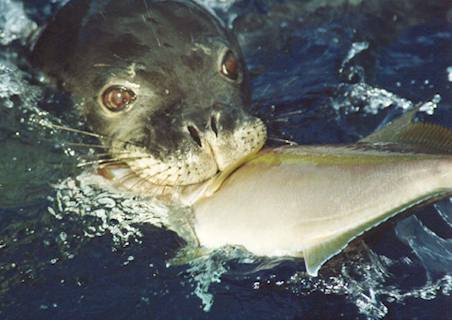
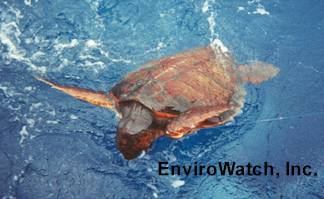
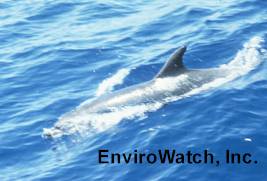
The Federally mandated program was officially established in 1994 by NMFS under Amendment 2 of the Pelagic Fisheries Management Plan in order to satisfy certain conditions of Section 7(a)(1) of the Endangered Species Act. Since then observers have been regularly deployed aboard Hawaii’s longline fishing vessels to monitor the incidental take of sea turtles by commercial fishermen targeting billfish and tuna. The observers also document the take of seabirds, such as the Laysan and Black-foot albatross, endangered Hawaiian monk seals, whales and other marine mammals.
FISH AND TELL
Before the observer program NMFS relied on the fishermen’s log books for statistical information on catch and bycatch. However, according to some at NMFS "the log books cannot be trusted because most fishermen fill them out improperly". In fact, NMFS’s own Biological Opinion confirms this by stating that "in Hawaii’s longline fishery there is a problem with species misidentification in the logbooks, particularly of sea turtles reported observed or taken, and that many skippers are unable to distinguish between juvenile loggerhead, green, olive ridley, and hawksbill turtles, especially when observing them from a distance."
Fishermen also tend to be wasteful with resources when money is involved, and do not report everything that is caught. For example, because of the low price fishermen gets for large billfish, when a 500-800 lb. billfish is found dead on the line it is often discarded to save ice (and space) for fish that fetch a higher prices, such as ahi (tuna).
 |
OBSERVING THE ACTION
What is the optimum number of observers for a program to adequately monitor the fishing industry under these circumstances? In a November 1998 Biological Opinion addressing concerns from conservationists NMFS stated: "Given the present level of fishing effort NMFS should strive to meet a 20% observer coverage rate for fishing trips by large vessels in the Hawaii-based longline fishery in order to obtain a more reliable estimate of incidental turtle take. The minimum acceptable number of observer trips should be 5-7% with a 90% confidence level".
Based on this statement it becomes apparent that even with the current level of 14 observers there may not be enough coverage to reach a meaningful level of statistics and that perhaps we should be adding observers, not taking them away. It now appears, based on recently released information, that from it’s inception NMFS may have never intended to see the program operating at the recommended level of 20% or even, as documented below, in an efficient and meaningful manner. In fact, up to now the program has, more often than not, operated at far below the suggested minimum of 5-7%.
Documentation shows that NMFS has never taken the program seriously. In 1995 they tried to privatize the observer program with a proposal that each boat owner pay $6,000 a year to a private contractor to continue the program. In 1998, after that proposal failed, they questioned whether the program should be continued based on statistics gathered at that point.
STATISTICS ARE IN THE TELLING
Here is an example of statistics gathered, and published, during a 6-month period in 1995. Judge for yourself how statistics can be used:
Of 29 trips, 11 had encounters with a total of 17 turtles. Of these, 2 were entangled in nets, 7 ingested the hooks, and the remainder had hooks in their head or beak. During the 29 trips 316 longlines were set containing approximately 325,000 hooks. Based on the number of hooks set statisticians concluded that .05 turtles were injured per 1000 hooks – and they deem this acceptable!
Somehow, based on statistics such as these, NMFS feels that data gathered since 1994 is sufficient to conclude that turtles have not been adversely impacted by longlines and that the observer program can easily be cut back, particularly with the Agency’s many budgetary problems. Attempts to obtain information on funding have proven difficult, but we were told by NMFS that this is not the only program with problems. However, in 1998 NMFS was able to generously support a large party celebrating the opening of the Humpback Whale National Marine Sanctuary. The many costly activities included snorkeling trips to the Islands of Kahoolawe and Lanai, a whale watch breakfast, and airfare and expenses for several NMFS employees from across the country.
Although NMFS has only made a minimum effort to comply with regulations requiring an observer program, they have been quick to make use of information garnered by the observers when it suits their needs to give legal justification to the fisheries or continue an ineffective bureaucracy that has a history of studying fisheries to death even as they crash one after another. It should be noted that most of the fishermen in Hawaii came here because the fisheries crashed where they came from. Without an adequate observer program, we will be the next to crash.
| BEING AN OBSERVER Based on records and comments just released it can be inferred that NMFS not only deliberately implemented the program in a way that would render it statistically useless but gave very little thought to the welfare of the observers they put onboard the boats. Even so, the observers have done an incredible job and should be commended for sticking it out under severe and adverse conditions. |
 |
It is not easy being an observer. The average trip is 23 days, but could extend up to six weeks. A normal work day is 10-15 hours spent watching every hook as it is retrieved from a fifty-mile longline. If there is an entanglement the "pull" could take up to 20 hours, and one observer noted that he saw "crews do sets back to back when the fishing was hot and work for 36 hours straight!".
Life aboard ship is primitive and can get rough at times. Take for example an incident involving an observer assigned to a vessel infested with bed bugs. He, too, became infested and ended up with hundreds of bites over his entire body. When he told his supervisor about the unhealthy conditions he was told, in a memo, that "vermin, such as cockroaches, bedbugs, etc. do not effect the observability of a vessel".
The observers are severely restricted as to what they can or cannot do. For example, they cannot carry personal cameras. They are allowed to use an "official" camera, but a NMFS memo dated 5/2/95 states: "Also, be reminded that photographs are only to be taken of turtles or unidentified birds, fish or marine mammals. No others should be taken." In other words, don’t be too thorough with your documentation.
Another memo, written in response to questions raised by an observer states: (Q) If the vessel you are on is boarded by the Coast Guard should you answer any questions they might ask (ie. regarding dope or plastic disposal?) the answer was "Yes, but don’t volunteer information, just answer questions asked". This response shows a willingness on the part of NMFS management to hinder the Coast Guard enforcement effort. More specifically, an October 27, 1994 memo issued by a high-level law enforcement supervisor contained similar instructions regarding the disclosure of information during a criminal investigation. It stated: "Tell anyone else that asks that we are still investigating. Keep the evidence and the investigation AWAY from the Coast Guard, including the visiting team".
The following is taken from the United States Coast Guard Report of Investigation of an incident involving the longline vessel Red October after it was hit by a rogue wave:
"One person operates the vessel 10-12 hours a day. At night the auto pilot is engaged without a helm watch. On December 9th seas were 8-10 feet, they built up to 25 feet with winds up to 45 knots. The wind shifted 90 degrees in 20 minutes.. The vessel started picking up at 0545 that morning. The captain was at the port control station. A couple of waves hit the vessel throughout the day. Vessel pulls along side the longline to retrieve it. A large wave hit the vessel starboard aft quarter so Eric could view the seas. He saw a very large, green wave, probably 50 feet tall. He couldn’t see the top of the wave even though they were on the crest of a large wave. The 50 feet wave hit the starboard aft quarter and rolled the vessel to it’s port side. Next recollection was that he was spinning underwater. When Eric surfaced he was on the port side of the vessel. Tuan was 10 meters away and Tan was 30 to 40 meters away. The other crewman was seen by the crew drifting out to sea. Some deck boards floated toward Eric. Eric tried to hold on to the boards as he was pulling on the fishing leaders trying to grab a hook. A large wave pushed Eric towards the vessel. The Captain grabbed Eric’s hand and tried to pull him aboard. Couldn’t get him up. Captain threw Eric a rope line from fishing hoist/winch. Eric was hurt and very tired and could only wrap it around him and lock the clasp around his wrist. Once on board Eric puked saltwater, was exhausted and couldn’t help rescue others. Some of the others were pulled aboard and one crew member was lost at sea".
Eric sustained several injuries: anemia (low red blood), collapsed lung, fractured coccyx and sacral, muscle breakdown through body and a puncture in left buttocks.
The Coast Guard investigation found that the vessel’s safety sticker had expired a few months earlier and that the observer’s supervisor had assigned Eric to work the vessel even though it was expired.
 |
WESPAC AND NMFS
Although the principle function of the observer program is to document interaction of turtles with longlines, a lot of the work being done by observers pertains to the collection of fish data. This data is used by the Western Pacific Regional Fishery Management Council (WESPAC) and it’s constituents as an aid in managing the fisheries. However, WESPAC, like NMFS, rejected the goal of attaining 20% coverage as cited in the Biological Opinion. What isn’t clear is why WESPAC is now requesting that the program only be restored to a level of 3%, particularly when they do not have to foot the bill. In response to questions from EnviroWatch, Inc, Kitty Simonds, Executive Director of WESPAC writes:
- WESPAC does not provide financial support for the observer program
- On the advice of statisticians at the NMFS Honolulu Laboratory, a coverage rate of 15 to 20% would be ideal for the longline fishery, but failing that 5-7% coverage would be desirable for statistical validity as noted in the Biological Opinion. However, NMFS Deputy Assistant Administrator, Andy Rosenberg, stated that a 3% coverage level is the norm for observer programs in the US.
- The Council will pursue this matter with NMFS with the utmost vigor to restore observer funding support to its previous levels.
CONCLUSION
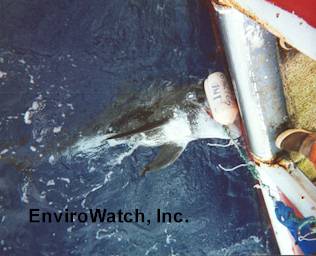
As photographs, recovered by EnviroWatch Inc. show, longliners are hooking whales and killing birds and other species in large numbers. Preliminary estimates indicate that between 1990 and 1994 the Hawaiian longline fishery killed 23,000 Laysan and Black-footed albatross. Interviews with observers suggest that this number may be low because so many interactions go unreported. Without observers aboard to hinder the wholesale slaughter of species, there’s no telling what may happen to our future. Jonathan Lono Kane, Regional Director for the Inland Boatsman’ Union of the Pacific has indicated the Union will possibly file unfair labor practice charges to restore the 12 unionized observer positions. Envirowatch, Inc., along with the Union, has obtained congressional support of the observer program. You can help by contacting Senators Inoyue and Akaka, and Representatives Abercrombie and Mink.
Carroll Cox can be contacted at www.envirowatch.org