Environmental Devastation at Grassy Narrows First Nation
We are located approximately 80 kms north of Kenora, Ontario close to the Manitoba Border (nw Ont.). Our band membership is over 1000 people with 700 people living on reserve. In addition we have about 100 non-band members that live and work in our community (teachers, police officers, etc.) The population is comprised of 70% youth and children.
Our Traditional Land Use Area is in excess of 4000 square kms and is known as a Boreal Forest on the Precambrian Shield. We are surrounded by many lakes and rivers and the water flows to the Hudson Bay. The forest is abundant with different types of wildlife: moose, deer, martens, rabbits, beaver, foxes, wolves, bears, eagles, and various birds. There are also many medicinal plants known and used by our people: treatments for diabetes, heart, sterility, skin problems and for many other ailments.
As Bernard Abraham President of Weskit-Chi Aboriginal Trappers Association wrote: "For the Aboriginals, the forest was their food bank, the drugstore, the meat market, the bakery, the fruit and vegetable stand, the building material centre, the beverage supply, and the habitat for all of the the CREATOR'S CREATURES."
History of Environment Devastation:
In 1972 we were shocked to find out that our fresh water was contaminated with mercury that was dumped from a paper mill 320 kms upstream. We have lived with the negative effects since then: Mercury poisoning which has produced various health problems, loss of traditional food and harvesting, and the loss of commercial fishing, and the loss of self esteem within the family circle. Grassy Narrows received compensation in the 1980's from the Reed Paper Company and the Federal government.
Our community suffered yet another upheaval as a result of flooding by Ontario Hydro. Our burial grounds and sacred sites were devastated, not to mention our wild rice fields. Our community had to contend with disarray as the water fluctuated to historical proportions and caused damage that can never be recovered.
Our community was relocated in the early 1960s by Indian Affairs, apparently to allow us better access to the nearest town, Kenora, and to benefit from what it has to offer. This in itself was a cause for trauma to our people. It displaced them and disoriented them for easier assimilation to the white society. Most of our youth and children now speak only english.
These experiences we consider to be genocidal are common to First Nations, as was the residential school experience.
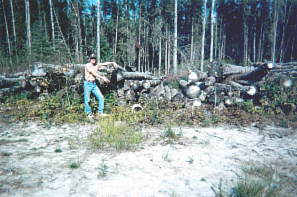
Our community is increasingly surrounded by clear cuts and despite our plight to stop clear cutting activities, we are not being heard. This issue has been ongoing as far back as late 1993. Associated with the actual impact of removing the trees are the other effects such as oil spills, garbage, use of herbicides, etc. Also hundreds of trees are commonly cut, piled and abandoned.
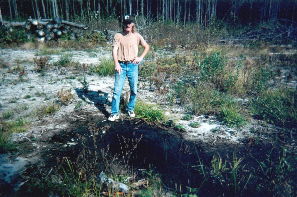
During maintenance on the machines that are used (skidders, tractors, and feller-bunchers) the old engine oil is apparently routinely dumped onto the ground. This could be several litres at a time. Often a discarded oil filter can be seen nearby.
The piles of abandoned trees are observed to be poplar and ash, some up to 2 feet in diameter. When pressed by us in regards to these issues, Abitibi tells us that they are doing ther best to stop it. The Ministry of Natural Resources tells us that they are powerless to stop it. Meanwhile the environmental degradation carries on.....
Attempts to stop this destruction is made more difficult because of the use of massive propaganda by Abitibi Consolidated Corporation. Recently Abitibi sent generic letters to many school children here inGrassy praising themselves and their role in forestry. This letter was misleading and insulting to Aboriginal People. Abitibi claimed to possess a spiritual tie to the land. To give further insult to our plight, the Kenora area has been designated as the Forest Capital of Canada, which totally undermines the efforts we have made to protest the massive clearcutting on our Traditional Land Use Area.
The issue of the 1990's is the further erosion of our culture by eradication of the last remaining areas of old growth forests within our Traditional Land Use Area. This area lies outside of our 14 square mile reserve. It has sustained us and our culture for thousands of years. The liquidation of the forest will restrict our culture and traditional activities and even eliminate many aspects of it (berry picking, hunting, trapping, medicine gathering).
To close off, there is possible nuclear waste dumping that might be occuring in the near future in our area because of our remoteness and lack of thought and concern from huge multinational companies and the governments.
So we appeal to you, as fellow concerned citizens of our planet, for your help in any of the following ways:
1) Donations to put towards a court injunction that will cost us a minimum of $45,000.00, and this does not include legal fees.
2) Write letters to the members of Parliament on our behalf.
3) Donations to put towards travel for a member of Grassy Narrows to enable us to bring forth the issues we have mentioned to other concerned environmentalists.
4) We request the delegates to spread the message we have given today of the plight of our Community.
5) To support us in our future efforts including; protests, boycotts or any other means necessary, in any way you can.
OUR CONCERNS ARE FOR THE HEALTH OF THE PLANET AND THE SURVIVAL OF OUR CULTURE.
- GRASSY NARROWS FIRST NATION
- GRASSY NARROWS ENVIRONMENTAL GROUP
- GENERAL DELIVERY
- GRASSY NARROWS, ONTARIO
- P0X 1B0
- PHONE: 807 - 925 - 2201
- TOLL FREE: 800 - 668 - 1790
- FAX: 807- 925- 2649
E-mail: fobister@voyageur.ca