|
| |
FIN SOUP
The shark fin fisheries industry has contributed to the decline of some shark species
and threatens numerous others. The impact is so great that parties to the Convention of
International Trade in Endangered Species of Wild Fauna and Flora (CITES), at their tenth
meeting of the Conference of the Parties in Zimbabwe, 6/20/97, stated the following in a
request for information from members:
(Conf. 9.17) |
 |
RESOLUTION OF THE CONFERENCE OF THE PARTIES
Status of International trade in Shark Species
NOTING the increase in the international trade in parts and derivatives of sharks, and
the document on this issue (Doc. 9.58) submitted by the United States of America:
CONCERNED that some shark species are heavily utilized around the world for their fins,
skins and meat;
NOTING that levels of exploitation in some cases are unsustainable and may be
detrimental to the long-term survival of certain shark species;
NOTING that, at present, sharks are not specifically managed or conserved by any
multilateral or regional agreement for the management of marine fisheries;
NOTING further the ongoing initiatives to foster international co-operation in the
management of fisheries resources;
CONCERNED that the international trade in parts and products of sharks lacks adequate
monitoring and control;
RECOGNIZING that the members of the IUCN Species Survival Commissions Shark
Specialist Group are currently reviewing the status of sharks and the global trade in
their parts and derivatives in the course of developing an action plan on shark
conservation;
CONSIDERING that the Conference of the Parties has competence to consider any species
subject to international trade;
RECOGNIZING that other intergovernmental organizations and bodies, including the Food
and Agriculture Organizations (FAO) of the United Nations, and the International
Commission for Conservation of Atlantic Tunas (ICCAT), have undertaken efforts to collect
elaborate statistical data on catches and landings of diverse marine species, including
sharks;
RECOGNIZING further that the collection of species-specific data is a complex task,
considering that there are some 100 species of sharks being exploited both commercially
and for recreation, and that numerous countries utilize this marine resource;
THE CONFERENCE OF THE PARTIES TO THE CONVENTION
URGES the Parties to submit to the Secretariat all available information concerning the
trade and biological status of sharks, including historical catch and trade data on shark
fisheries;
 |
|
 |
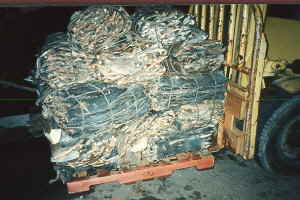
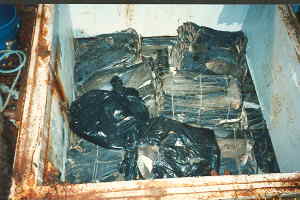
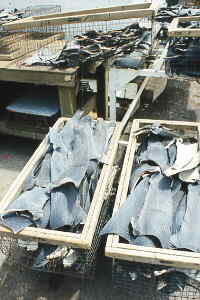
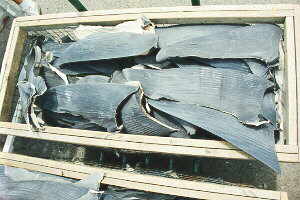
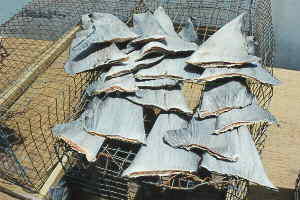
| There are no tags or other markings on these shark fins |
The National Marine Fisheries Service, in recognition and understanding of the
impending crisis and, in a response to CITES request for information, presented a
discussion paper entitled An Overview of the Biological Status of Shark Species. In
it they stated:
"The limitations on available data on shark fisheries worldwide and the difficulty
in interpreting much of this information can be summarized as follows:
- Lack of basic life history information (growth rate, longevity, age at maturity,
fecundity, recruitment).
- Lack of population data (temporal and spatial distribution in general and by sex and
age, migratory nature vs. Site fidelity, schooling dynamics, lack of baseline population
data, lack of understanding of stock structure and population dynamics
- Lack of or unreliable nature of specie specific catch and effort data with size at
capture
- Reluctance of some nations and fishermen to submit catch and effort or bycatch data
- Misleading or significantly incomplete published catch statistics for shark fisheries
- Lack of fishery-independent shark data
- Lack of fishery management or management plans
- Lack of ecological studies (habitat requirements, predator-prey relationships, etc)
| Even though sharks are on the decline and there is a lack of
information, in general, NMFS in |
 |
|
Hawaii has authorized the transshipment of shark fins from boats that
fish anywhere in the world. The sharks are either intentionally caught or are the by catch
of other fishing activity. These may include longlines, drift gill nets, or pair trawling.
The majority of the sharks are brought along side or aboard the vessels where the
fishermen cut off their fins and toss the carcasses back into the ocean, sometimes alive
but eventually to die. This is how it works as explained by Elaine of Norko Marine
Agency Inc: |
"A supply vessel roams the worlds oceans, refueling and resupplying fishing
boats. The fishing boats sell their shark fins to the supply vessel, where they are
accumulated until they rendevous with an American fishing vessel approximately 200 miles
from Hawaii, on the high seas. The American vessel transports the fins to Honolulu where
they are placed in containers and shipped out."
When asked what types of sharks, where they were from, and how many sharks were caught
she stated that she did not know. Officials from the National Marine Fisheries Service
said they did not know either and suggested that I contact the State for information on
transshipments. They told me the State kept records on shark fin landings. I contacted the
State and was told that they did not know anything about transshipments and I should
contact the National Marine Fisheries Service. At this point I started to hum "Just
Follow the Bouncing Ball".
Apparently the National Marine Fisheries Service has once again dropped the ball and
show that the only animal they are really concerned with is the "buck" and the
"fin".
HOW YOU CAN HELP:
The National Marine Fisheries Service needs to be prodded into taking a proactive
approach in managing sharks. Help us save the sharks by writing NMFS and telling them that
you are interested in protecting sharks as well as other marine life.
Contact:
- The Honorable William M. Daley, Secretary of Commerce
- U.S. Dept of Commerce, Rm 5854
- 14th & Constitution Ave. NW
- Washington, DC 20230
-
- Email: WDaley@doc.gov
- Fax: 202-482-2741
- Phone: 202-482-2112
-
- President William J. Clinton
- 1600 Pennsylvania Ave., NW
- Washington, DC 20500
-
- Email: president@whitehouse.gov
- Fax 202-456-2461

return to EnviroWatch home page
|